In modern aesthetic practice, one of the most common patient complaints remains skin dryness, reduced tone, dull complexion, the appearance of fine lines, and a general sense of "tired-looking" skin. These changes often become noticeable as early as the age of 25-30, when fibroblast activity gradually declines and the synthesis of key extracellular matrix components, including hyaluronic acid, decreases.
Against this background, biorevitalization has established itself as a core procedure in aesthetic medicine, primarily aimed at restoring skin hydration, improving overall skin quality, and correcting early to moderate signs of aging.
Biorevitalization is a procedure involving the intradermal administration of hyaluronic acid-based products. Its main objective is not merely to moisturize the skin, but to restore water balance, enhance cellular metabolic activity, and improve the functional quality of the dermis.
It is essential for practitioners to understand that biorevitalization is not just an injectable treatment for dryness, but a method for correcting age-related and stress-induced skin changes by working with tissue hydration reserves, the extracellular matrix, and the fibroblast microenvironment.
In this article, we will explore the core principles of biorevitalization and its key clinical indications.
Biorevitalization: Mechanism and Clinical Indications
Hyaluronic acid is one of the key components of the extracellular matrix, known for its strong hydrophilic properties. Its ability to bind and retain water molecules largely determines the level of skin hydration, elasticity, density, and overall visual freshness.
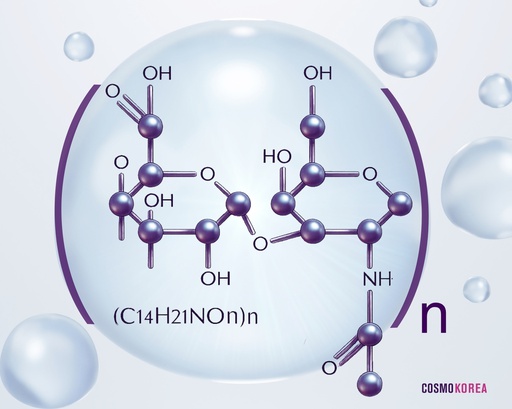
Under normal conditions, hyaluronic acid is synthesized by fibroblasts. However, with age, as well as under the influence of ultraviolet radiation, chronic stress, smoking, inflammation, and other damaging factors, its endogenous production gradually declines.
Clinically, this manifests as:
increased skin dryness and thinning
reduced turgor
formation of fine lines
dull, uneven complexion
increased skin reactivity
slowed regenerative processes
Biorevitalization compensates for this deficiency by delivering hyaluronic acid directly into the skin. Modern formulations may also include amino acids, antioxidants, vitamins, peptides, and other components that enhance the skin's regenerative capacity.
From a clinical perspective, the effect of biorevitalization is not limited to moisture replenishment. It also improves the functional state of the dermis, leading to:
increased hydration levels
improved elasticity and tone
reduction of fine lines
more even skin tone
improved texture
accelerated recovery after external damage
For this reason, biorevitalization is considered a skin quality treatment rather than a method for structural correction or significant lifting.
Types of Biorevitalization
In clinical practice, two main types of biorevitalization are used: injectable and non-injectable.
Injectable Biorevitalization
Injectable biorevitalization remains the most widely used method due to its precision and predictable outcomes. The product is delivered directly into the dermis, either manually or using specialized devices.
This approach is particularly effective for:
dehydrated skin
fine wrinkle aging type
reduced skin tone
post-procedure recovery
Non-Injectable Biorevitalization
Non-injectable methods rely on physical technologies such as laser, ultrasound, galvanic current, magnetic waves, and oxygen pressure to deliver active substances into the skin.
These methods are suitable for patients with low pain tolerance, fear of injections, or when a gentler protocol is required. However, it is important to note that both the depth of delivery and clinical effectiveness may be lower compared to injectable techniques.
Key Indications for Biorevitalization
Biorevitalization is most effective in clinical situations where dehydration, reduced skin quality, and early aging changes are the primary concerns.
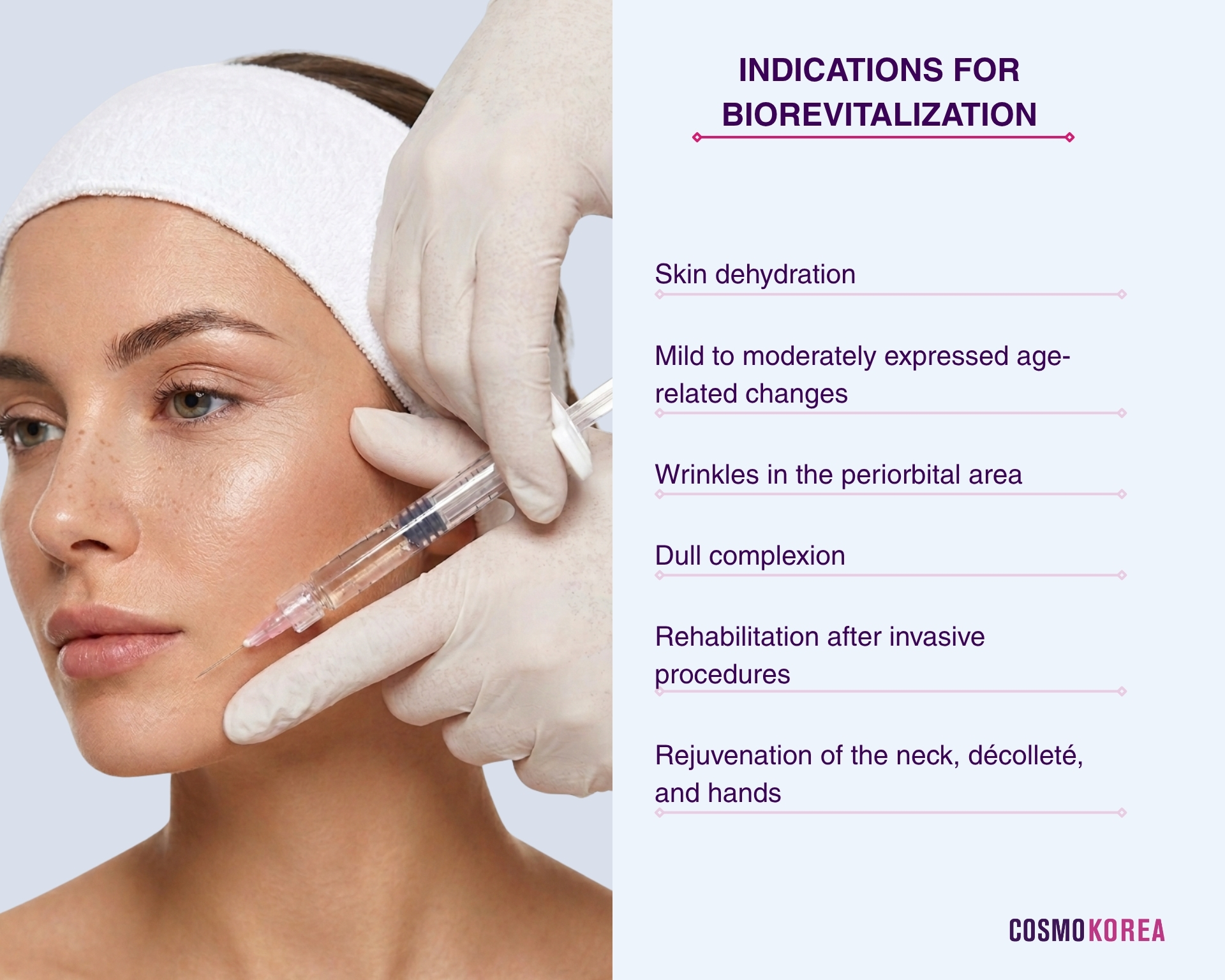
Dehydrated and Dry Skin
This is one of the main indications for the procedure. When moisture levels decrease, the skin loses smoothness, becomes more sensitive, reacts more strongly to external factors, and appears fatigued.
Biorevitalization helps to:
restore hydration
reduce tightness
improve barrier function
enhance overall skin appearance
The effect is particularly noticeable in patients with dry skin, as well as after sun exposure, air travel, cold weather, or dry environments.
Early and Moderate Signs of Aging
When fine lines appear and skin elasticity declines, biorevitalization becomes one of the most physiological treatment options.
It is especially effective in:
fine wrinkle aging type
educed skin tone
dull complexion
uneven texture
early loss of elasticity
It is important to note that biorevitalization does not replace lifting procedures in cases of significant ptosis, but it significantly improves skin quality and slows visible aging.
Periorbital Area
The skin around the eyes is particularly thin and highly sensitive to moisture loss.
Biorevitalization in this area helps to:
reduce dryness
improve skin quality
minimize fine lines
In some patients, it also reduces dullness and the appearance of fatigue.
Dull Complexion and Poor Skin Quality
Many patients are concerned not with isolated wrinkles but with overall skin quality.
After a course of biorevitalization, patients typically notice:
more even skin tone
reduced dullness
improved density and fullness
healthier overall appearance
Post-Procedure and Environmental Recovery
Biorevitalization is widely used as part of recovery protocols after sun exposure, chemical peels, and other stress-inducing factors.
Its role in such cases is to:
accelerate skin recovery
restore hydration
reduce stress-induced damage
enhance regeneration
Neck, Decollete, and Hands
Although commonly associated with the face, biorevitalization is also highly effective for other areas prone to aging:
neck
decollete
hands
These areas tend to lose moisture quickly and show early signs of aging, making them ideal targets for the procedure.
When Biorevitalization Is Not the Optimal Choice
Despite its wide range of applications, biorevitalization is not a universal solution.
It should not be considered the primary method for:
pronounced gravitational ptosis
significant volume loss
deep static wrinkles
strong lifting requirements
correction of muscle hyperactivity
In such cases, it may be used as a supportive treatment but not as a replacement for more targeted procedures.
Conclusion
Biorevitalization holds a unique position in aesthetic medicine because it works not with facial structure, but with skin quality. Unlike procedures aimed at altering volume or muscle activity, it operates at a more fundamental level: hydration, extracellular matrix integrity, and dermal cell function.
Therefore, its role extends far beyond simple moisturization. In clinical practice, it serves as a tool for restoring the physiological potential of the skin, creating optimal conditions for regeneration, improving tissue density, and slowing down aging processes.
Its effectiveness is greatest when dehydration and reduced skin quality are the primary issues.
Thus, the key to its proper use lies not in selecting a procedure based solely on symptoms, but in understanding the underlying pathogenesis. In this context, biorevitalization becomes not just a standalone treatment, but part of a comprehensive strategy aimed at achieving healthy, functional skin and long-term aesthetic results.