A loss of hair density does not always begin with noticeable shedding. Sometimes the first change is a widening part, a receding hairline, or gradual thinning of individual hairs. Similar-looking manifestations may have different causes, so effective management of alopecia should begin with identifying the underlying mechanism.
In this article, we will examine what happens to the hair follicle in androgenetic alopecia, how male and female patterns of thinning differ, how stress affects hair growth, and what role polynucleotide-based products may play in a comprehensive approach.
Alopecia: What Happens to the Hair Follicle
The hair follicle is a dynamic structure whose function depends on interactions between cells and the surrounding tissues. The dermal papilla plays an important regulatory role: its signals help control hair growth and the activity of follicular cells.
The follicle’s life cycle includes three main stages:
Anagen — the period of active hair growth.
Catagen — a transitional stage during which growth stops and the lower portion of the follicle undergoes restructuring.
Telogen — the resting phase, associated with subsequent hair replacement.
The coordinated succession of these phases ensures the renewal of the hair. Changes in their duration alter the balance between growing and shedding hairs.
In androgenetic alopecia, follicular miniaturization becomes the key process. Individual hairs gradually lose thickness, become shorter and less visible, and consequently reduce overall hair density. These changes are driven by hereditary predisposition and the way androgens affect susceptible follicles.
One of the significant contributors to this process is dihydrotestosterone — DHT. Its action is associated with a shorter growth phase and the formation of finer hairs. Both hormone levels and the sensitivity of follicles to androgen signals are important.
Male and Female Alopecia: Differences in Clinical Presentation
In men, changes usually begin in the frontotemporal regions and at the crown. The hairline gradually recedes, and areas of thinning may merge over time. Hair in the occipital region is generally better preserved, reflecting differences in the sensitivity of follicles in different areas of the scalp.
In women, loss of density more often manifests as a widening central part and reduced hair density in the parietal region. The frontal hairline frequently remains intact. This pattern of thinning does not usually lead to complete hair loss, but it can significantly change hair volume and appearance.
Female-pattern thinning is not always associated with excess androgens: their role is less clear-cut than in male androgenetic alopecia. However, hair loss accompanied by menstrual irregularities, pronounced acne, or excessive facial hair growth requires evaluation for hyperandrogenism.
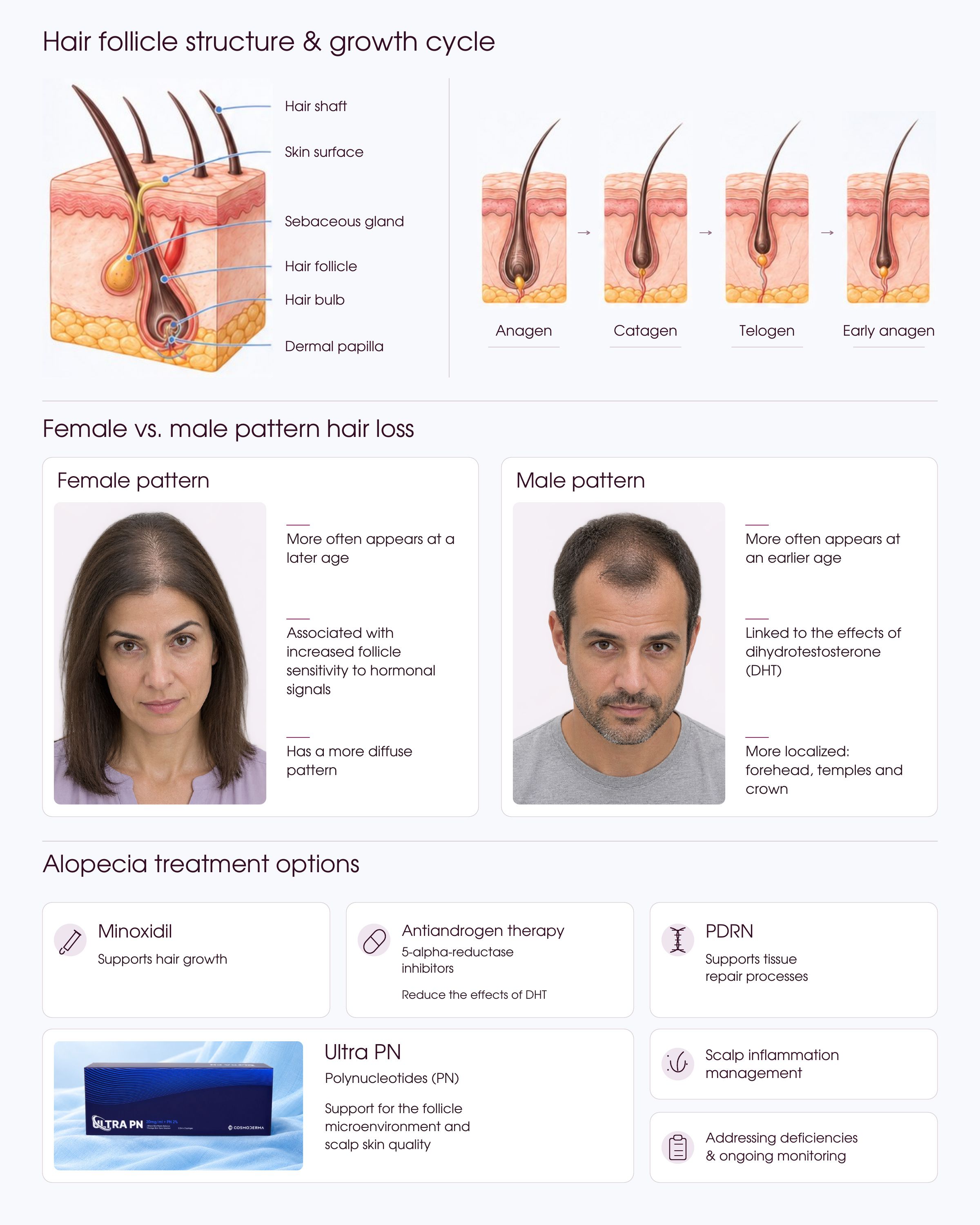 The structure and life cycle of the follicle, types of alopecia, and approaches to treating increased hair shedding
Chronic Stress and Alopecia: Neuroendocrine Mechanisms
The hair follicle responds to changes in both hormonal and stress-related regulation. Experimental studies show that stress hormones can alter dermal papilla signals and prolong the quiescent state of follicular stem cells.
In clinical practice, stress may trigger telogen effluvium: an increased number of hairs enter the resting phase and subsequently shed. The changes are usually diffuse and become noticeable several months after the triggering event. This is why patients do not always associate the shedding with the stress they experienced.
A Comprehensive Approach: What the Cosmetologist Should Consider
The assessment begins with clarifying the timing and pattern of hair loss, family history, medications being taken, and accompanying complaints. Examination of the scalp under magnification helps assess the condition of the hair and identify a possible cause of thinning. When necessary, the assessment is supplemented with laboratory tests or a biopsy.
Tests are ordered according to clinical indications. For example, suspected iron deficiency or thyroid dysfunction requires further investigation. This makes it possible to identify conditions that may accompany or aggravate hair loss without prescribing a universal panel of tests for every patient.
Thus, a comprehensive approach is not about looking for an inevitable “hormonal imbalance,” but about identifying factors that are genuinely relevant to the individual.
Approaches to Treating Alopecia
1. Supporting Hair Growth
Topical minoxidil remains one of the main treatments for androgenetic alopecia. Its use may slow further thinning and stimulate hair growth. However, the result develops gradually: effectiveness should be assessed after several months of regular use rather than after the first few weeks.
2. Reducing the Influence of Androgens
When appropriately indicated, products that reduce dihydrotestosterone formation or limit androgen activity are used. Finasteride is one option for men; in women, a physician may consider antiandrogen therapy, including spironolactone.
Such prescriptions require an individual assessment of contraindications and potential adverse reactions. Reproductive plans are particularly important: several medications used for alopecia are contraindicated during pregnancy. The choice of therapy should be discussed with a physician rather than determined solely by the severity of thinning.
3. Addressing the Follicular Microenvironment: PDRN and Polynucleotides
An additional approach involves supporting repair processes in the scalp. In this context, the use of polydeoxyribonucleotides — PDRN — and especially polynucleotides (PN) is being investigated. In particular, preclinical studies have shown that polynucleotides influence wound healing and blood vessel formation, which explains the interest in their regenerative potential.
Ultra PN: Supporting Scalp Condition
One product that may be used to address alopecia is Ultra PN. This serum contains polynucleotides — PN — at a concentration of 20 mg/mL. It is currently believed that polynucleotide chains improve skin hydration and enhance repair processes in the dermis. In the context of alopecia, this primarily involves addressing the tissue environment of surviving follicles rather than directly suppressing androgen-related mechanisms. It is important to note that the gradual breakdown of polynucleotide chains into smaller fragments is key to the formation of new extracellular matrix and also provides a basis for the repair of the patient’s own DNA. Moreover, the observed result is maintained over an extended period due to the gradual release of DNA fragments at the application site.
4. Controlling Inflammation and Damaging Factors
Itching, redness, tenderness, and pronounced scaling require a separate assessment. If an inflammatory or infectious scalp condition is present, additional antiviral/antibacterial or other therapy is necessary.
5. Correcting Associated Disorders and Follow-Up
If a patient has been diagnosed with deficiencies in trace elements and major minerals, the cosmetologist may prescribe iron, zinc, or selenium preparations and recommend revising the dietary plan to increase the proportion of protein-rich foods.
It is important to note that a long-term strategy includes assessing treatment tolerability and changes in the degree of thinning. In androgenetic alopecia, the need for maintenance therapy should be discussed in advance: discontinuing effective treatment may be followed by a gradual loss of the results achieved.
Conclusion
The management of alopecia begins with distinguishing processes that may appear similar: follicular miniaturization, increased telogen shedding, and accompanying scalp conditions. This determines not only the choice of products but also how realistic the expected outcome is.
An individualized strategy is based on treating the diagnosed form of alopecia, correcting confirmed abnormalities, and providing consistent follow-up. As an adjunct, regenerative approaches, including polynucleotide-based products, demonstrate high effectiveness.
Accurate diagnosis and the individualized selection of a treatment protocol are key to effectively managing increased hair shedding.
References:
1. Gupta M., et al., 2016, J. Cutan Aestet. Surg.
2. Gentile P., 2022, Int. J. Mol. Sci.
3. Scott-Salomon E., et al., 2026, Cell
4. Quist S.R., et al., 2021, Signal Transduction and Targeted therapy